Chiesa di Sant'Agostino - Veroli
(English version below)
Chi percorre il corso Beata Maria Fortunata Viti per raggiungere piazza Giuseppe Mazzoli, scorge innanzi a sé la facciata della chiesa dell'Annunziata, comunemente chiamata Sant'Agostino.
Notizie relative alla chiesa le abbiamo grazie allo scritto lasciatoci da mons. Adolfo Brocchi, rettore della chiesa per oltre 40 anni, dal titolo "Brevi notizie storiche della chiesa della chiesa SS Annunziata, detta Sant' Agostino" (Veroli, 1960). Secondo con mons. Brocchi la chiesa è stata eretta nel sec. XIV ed originariamente aveva il tetto "a doppio spiovente, sorretto da tre capriate di legno con travetti trasversali e mattoni di terracotta variamente decorati in rosso ".
Alla chiesa era annesso l'ospedale della Santissima Annunziata: questa notizia è confermata dal verbale della Sacra Visita effettuata dal vescovo Mons. Laurelli nel 1581, dove si legge: "Hospitale SS.mae Annunciationis regebatur a Societate mulierum sub titulo SS.mae Annunciationis existenie in Ecclesia Fratum Agustini ".
Nella suddetta chiesa si trasferirono i frati agostiniani dopo la distruzione del loro convento avvenuta nel 1556, ad opera delle truppe spagnole guidate dal Duca d'Alba, Viceré di Napoli, il quale combatteva contro le truppe francesi sostenute da Pio IV. Il convento era stato costruito nel XIII sec. presso la Fontana del Lago. I religiosi furono accolti benevolmente dalla popolazione del centro, e tutti gareggiarono per aiutarli. La stessa municipalità intervenne concretamente, assegnando ai frati, un contributo di 10 "carlini" ogni sei mesi. Tale decisione della comunità civile in favore dei religiosi fu inserita nello Statuto cittadino, all'articolo 84 che recitava: "In onore e gloria di Dio onnipotente, della Beata Vergine Maria e di S. Agostino, il Camerario deve pagare per la fabbrica e riparazione della chiesa e del convento di S. Agostino in Veroli 10 carlini, che non possono essere stornati in alcun modo. Il versamento si deve fare appena il nuovo Podestà, dopo aver preso possesso, prende la prima paga ".
I frati agostiniani con solerzia ripararono ed ampliarono, sia il convento, sia la chiesa che da allora fu chiamata di S. Agostino.
II professore Arduino Scaccia Scarafoni afferma di aver rinvenuto,presso l'archivio di casa Molella, uno scritto secondo il quale durante l'occupazione francese, la municipalità si trasferì presso il convento abbandonato.
Nel corso dell'occupazione, era stata messa all'asta tutta la suppellettile della chiesa; si deve ai canonici della cattedrale, di S. Erasmo e di S. Paolo, se gran parte della stessa fu riscattata e restituita. Va doverosamente segnalato l'intervento di tal Filippo Passeri che riscattò, a sue spese, la restante suppellettile.
113 giugno del 1818, il Vicario Generale degli Agostiniani, fra Settimio Rutelli, con apposito provvedimento concesse a padre De Bobus (unico agostiniano rimasto nel convento) di tener in vita la Confraternita dei Cinturati e Cinturate del S. P Agostino.
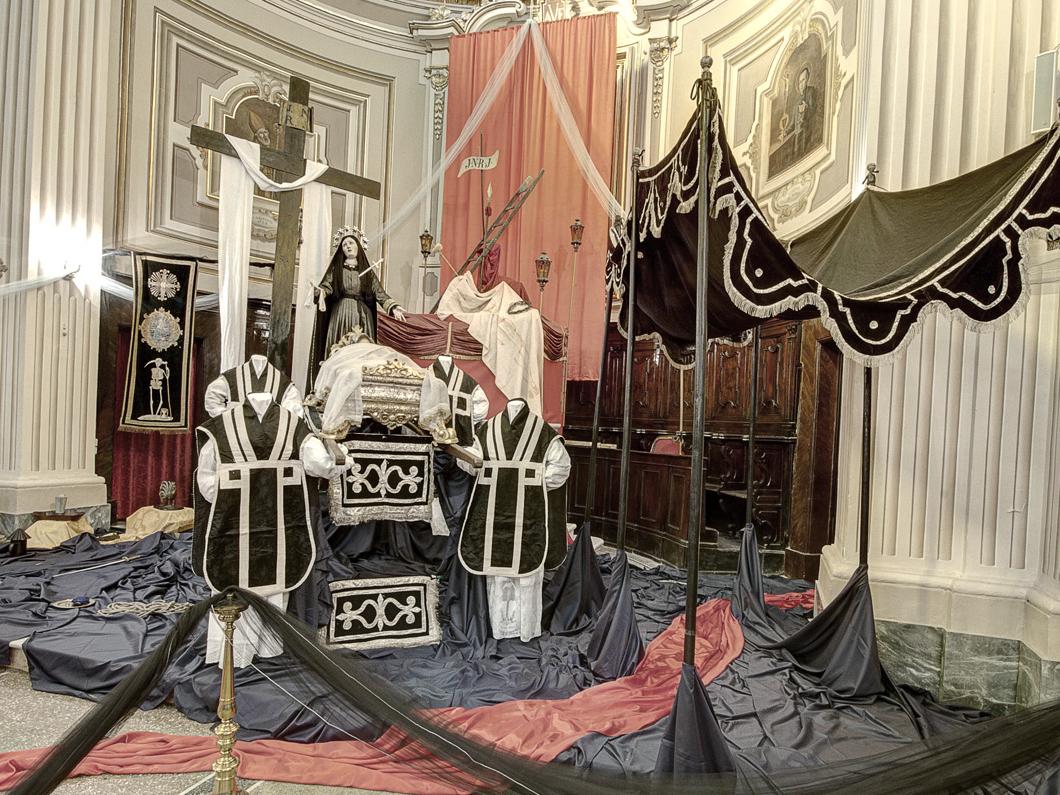
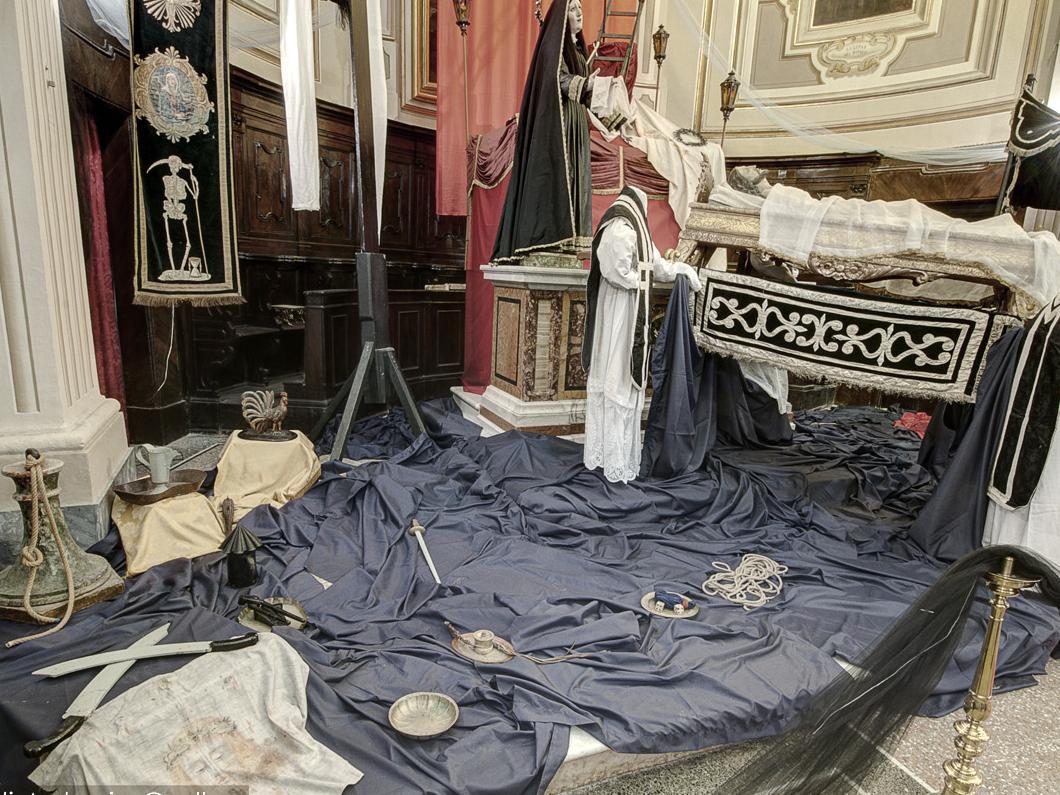
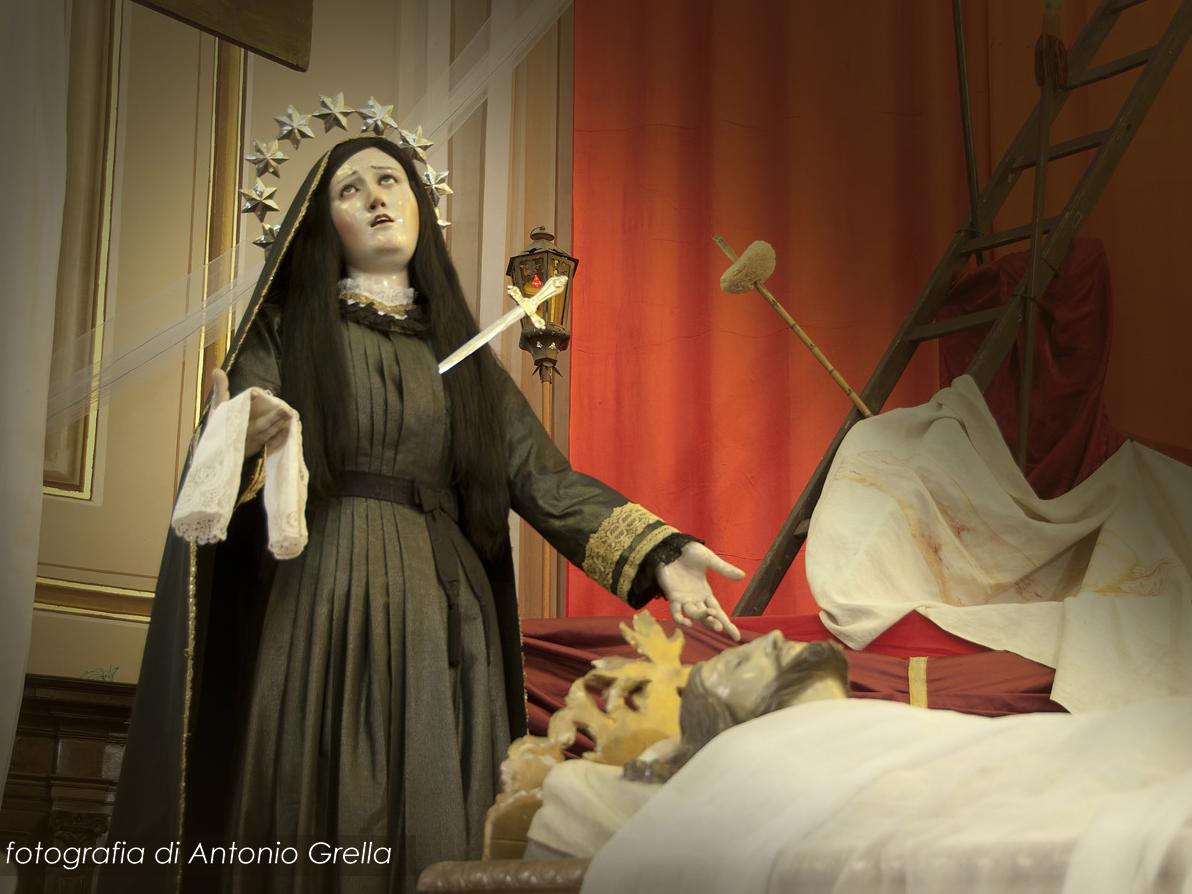
Altre trasformazioni ed interventi interessarono la chiesa nel secolo XVIII, allorché fu abbellita di nuovi stucchi e pitture. Tra la fine dell'ottocento ed i primi del novecento la chiesa fu chiusa al culto perché fatiscente. La confraternita della Morte Carità ed Orazione e Pia Unione dell'Addolorata, che aveva sede nella prospiciente chiesa di S. Nicola, in data 18 febbraio 1920 inoltrò richiesta al vescovo Mons. Fantozzi per ottenere la chiesa di S. Agostino come propria sede. La richiesta fu accolta, ed il vescovo emise apposito decreto il 2 marzo 1920, da quel giorno ogni lavoro è stato a totale carico della confraternita. Molti restauri furono eseguiti dai confratelli nei mesi successivi e la chiesa fu riaperta il 19 settembre dello stesso anno. Alcuni anni dopo vi fu sistemata definitivamente anche la bella statua della Vergine Addolorata.
A ricordo dell'anno Mariano (1954) la chiesa subì un nuovo radicale rinnovamento: furono abbattuti il tetto e la volta a cannucciato, nonché i muri fino al cornicione della navata, e ricostruiti in cemento armato su progetto e direzione dell'architetto Vittorio Papetti; il pavimento a mattonacci fu sostituito con il battuto alla veneziana; un gruppo di bravi artisti verolani, sotto la guida del maestro Rodolfo Mauti, eseguì il restauro pittorico avente come tema l'esaltazione della Vergine Santissima. I lavori iniziati nel giugno del 1955 furono portati a termine nel settembre del 1956. La nuova facciata, fu realizzata nel 1967.
Tra il 1999 ed il 2000, mentre era commissario della confraternita il sottoscritto, affiancato dal rettore mons. Francesco Mancini, furono restaurate le sei cappelle laterali. I lavori furono finanziati da cinque benemerite famiglie verolane e da un gruppo di "signore" di Fresinone. Sin dai primi giorni del 2000, il direttivo della confraternita, che vide rieletto per acclamazione il Tarquini come camerlengo, in vista del quinto centenario della fondazione della Confraternita (1506-2006) ha impegnato ogni energia per procedere al restauro pittorico della chiesa, alla manutenzione ordinaria e straordinaria dei monumentali confessionali, candelieri ecc. ed alla revisione del tetto. I lavori furono eseguiti prima della riapertura della chiesa, avvenuta la sera del sabato precedente la domenica delle Palme del 2006. Il simulacro della Vergine, prima della messa vespertina, lasciò processionalmente la concattedrale di S. Andrea e tornò nella "sua casa"" splendente di ori.
Nella cappella di sinistra, entrando nella chiesa, la sera del 14 maggio del 2006, dopo una solenne liturgia svoltasi in S. Andrea presieduta dall'Abate di Montecassino S. E. don Bernardo D'Onorio, fu benedetta la lapide posta a ricordo dell'avvenimento.
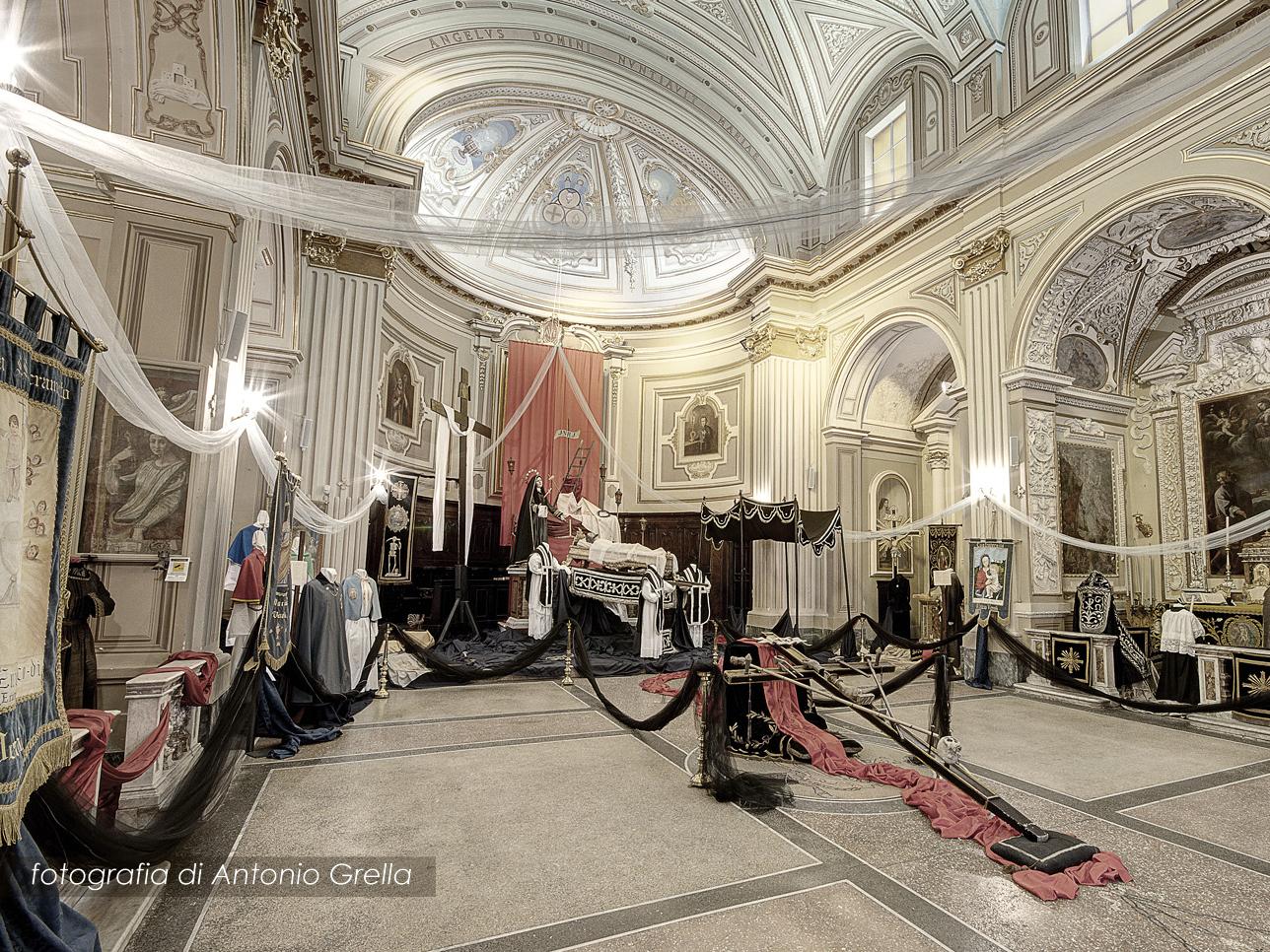
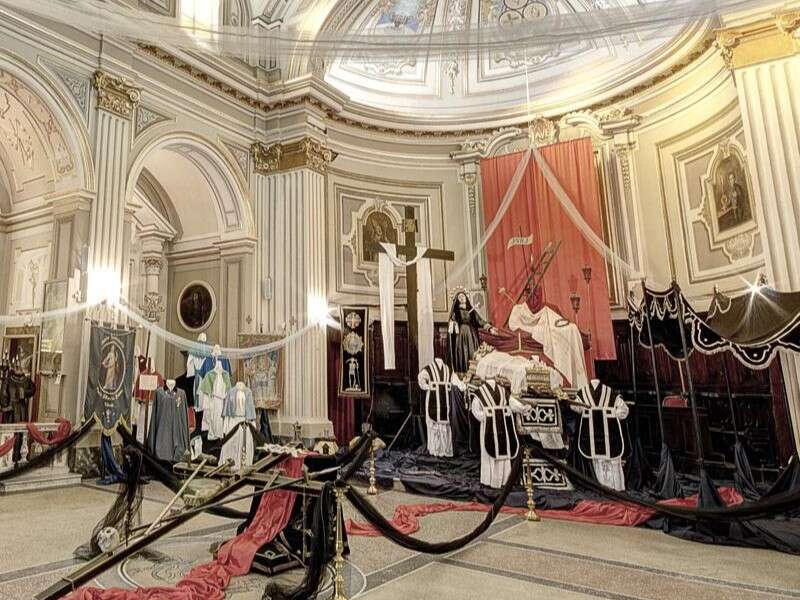
La chiesa ha una navata centrale con abside e sei cappelle; nell'abside vi è un coro settecentesco ed al centro una tela raffigurante l'Annunciazione attribuita al Mango. Nelle pareti laterali il pittore verolano Rodolfo Mauti ha dipinto S. Agostino e S. Gaspare del Bufalo. I lavori dell'altare, sistemato secondo le nuove norme, sono stati offerti dalla famiglia Iannarilli.
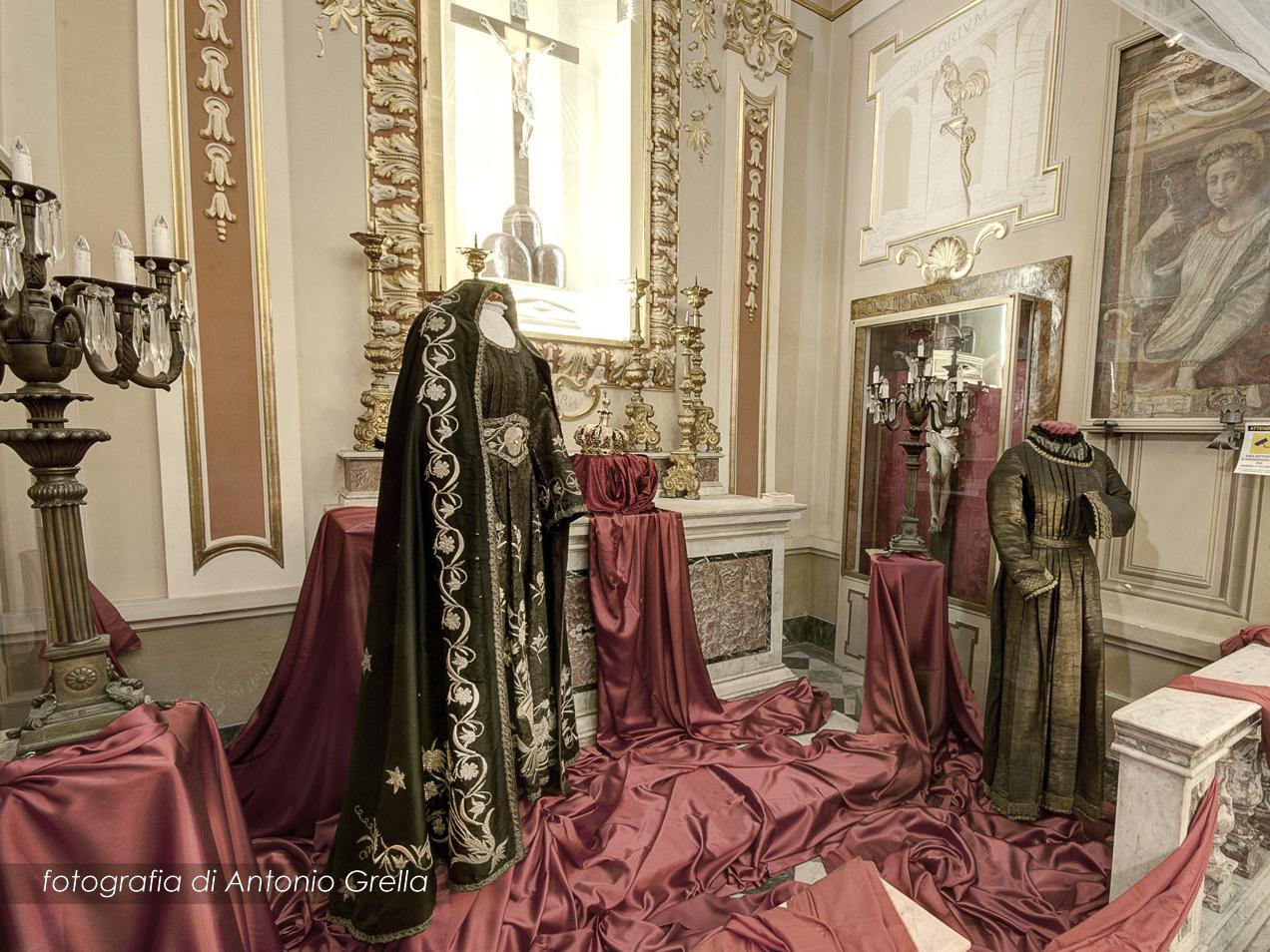
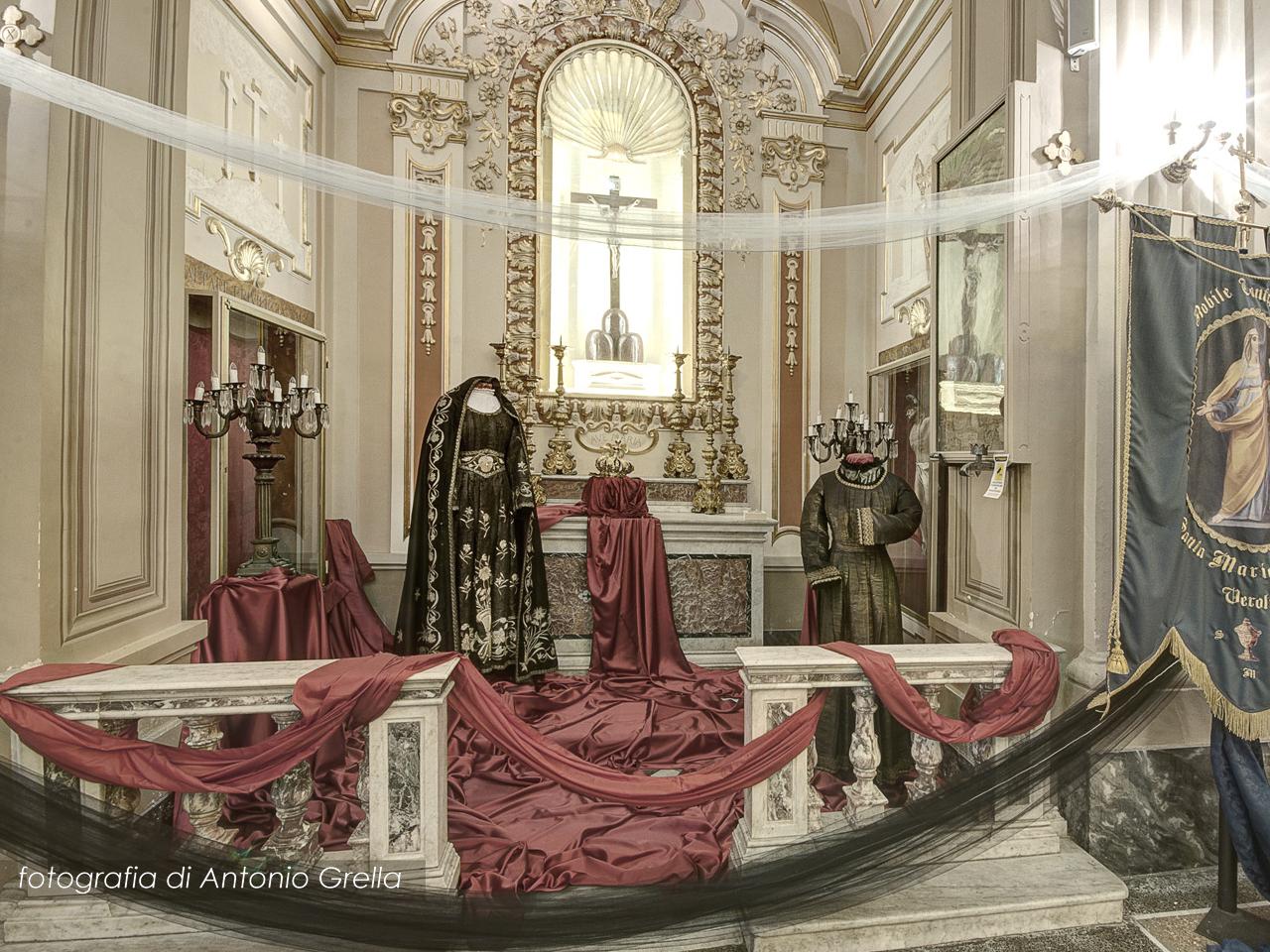
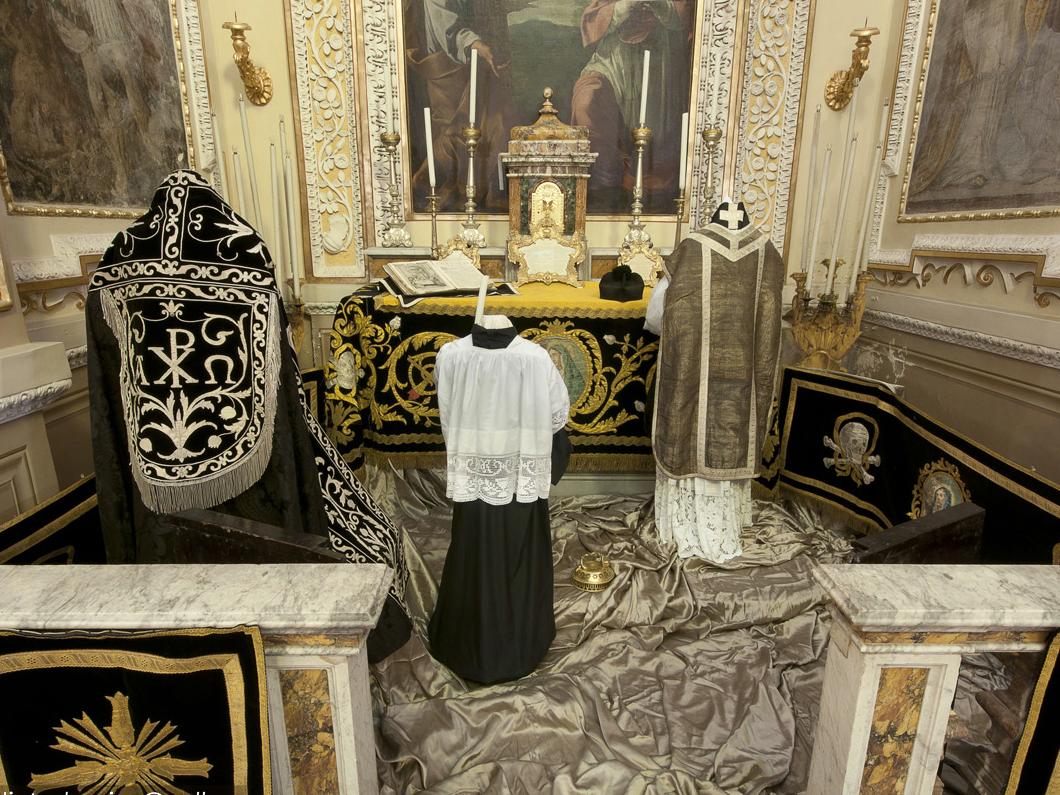
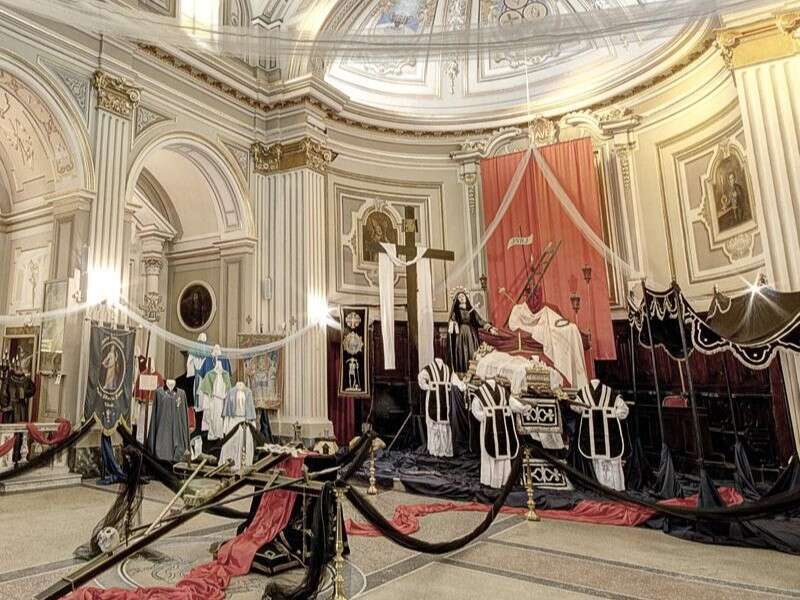
La prima cappella a sinistra è dedicata a S. Nicola da Tolentino e sotto l'altare marmoreo è posto il "Cristo morto'", anch'esso offerto dagli Iannarilli, Orlando, Umberto ed Angelo. La seconda cappella custodisce il simulacro della Vergine Addolorata, un bel Crocifisso e lo stendardo della Pia Unione. In essa ha trovato sistemazione un affresco riproducente Santa Apollonia, protettrice dei dentisti, che fu "tagliata " dalla parete allorché fu realizzata la nicchia dove è posta l'Addolorata. La terza cappella ha l'altare ornato da antiche maioliche ed è dedicata a S. Agostino e S. Monica. A destra di chi entra nella Chiesa di Sant'Agostino, la cappella di S. Pietro e S. Carlo Borrromeo dove trovasi la cappella dedicata a S. Filippo Neri con, sotto l'altare, il presepe, ed è ornata anche da due quadri e dalla lapide del quinto centenario. Segue la Cappella Melloni, ricca di stucchi, con due affreschi murali; sull'altare è posto il tabernacolo. L'ultima cappella ha due nicchie: nella centrale, sopra l'altare, vi è S. Rita, in quella laterale S .Teresa, oltre alla tela raffigurante S. Apollonia e S. Agata.
Il convento annesso alla chiesa ospitò dal XV secolo, fino alla fine del 1700, ben tre ordini religiosi: gli Agostiniani (dal 1556 agli ultimi anni de 1700), i religiosi del Preziosissimo Sangue, chiamati anche Bufalini dal nome del fondatore S. Gaspare del Bufalo (dal 1859 al 1879), ed in ultimo i Cappuccini, dal 1890 al 1894, quando una prima comunità di frati giunse a Veroli, dove attese la costruzione del nuovo convento presso la Fontana del Lago. Negli anni '70 fu confiscato dallo Stato Italiano e divenne stabilimento tipografico.
Those who walk along Corso Beata Maria Fortunata Viti toward Piazza Giuseppe Mazzoli will see before them the façade of the Church of the Annunciation, commonly known as Sant’Agostino.
Information about the church comes from a work written by Monsignor Adolfo Brocchi, rector of the church for over forty years, entitled Brief Historical Notes on the Church of the Most Holy Annunciation, Known as Sant’Agostino (Veroli, 1960). According to Mons. Brocchi, the church was built in the 14th century and originally had a double-pitched roof supported by three wooden trusses with transverse beams and terracotta bricks variously decorated in red.
Attached to the church was the Hospital of the Most Holy Annunciation. This is confirmed by the record of the Sacred Visitation carried out by Bishop Mons. Laurelli in 1581, which states: “Hospitale SS.mae Annunciationis regebatur a Societate mulierum sub titulo SS.mae Annunciationis existentie in Ecclesia Fratum Agustini.”
The Augustinian friars moved to this church after the destruction of their convent in 1556 by Spanish troops led by the Duke of Alba, Viceroy of Naples, who was fighting against French forces supported by Pope Pius IV. The convent had been built in the 13th century near the Fontana del Lago. The friars were warmly welcomed by the local population, who competed to help them. The municipality itself intervened concretely by granting the friars a contribution of 10 “carlini” every six months. This decision of the civic community in favor of the religious was included in the city statutes, Article 84, which read: “In honor and glory of Almighty God, of the Blessed Virgin Mary, and of St. Augustine, the Camerlengo must pay for the construction and repair of the church and convent of St. Augustine in Veroli 10 carlini, which may not be diverted in any way. The payment must be made as soon as the new Podestà, after taking office, receives his first salary.”
The Augustinian friars diligently repaired and expanded both the convent and the church, which from then on was called the Church of St. Augustine.
Professor Arduino Scaccia Scarafoni states that he found, in the Molella family archive, a document according to which, during the French occupation, the municipal administration moved into the abandoned convent. During that occupation, all the church furnishings were put up for auction. Thanks to the canons of the cathedral and of the churches of St. Erasmus and St. Paul, much of the furnishings were redeemed and returned. Special mention must be made of Filippo Passeri, who redeemed the remaining furnishings at his own expense.
On 13 June 1818, the Vicar General of the Augustinians, Fr. Settimio Rutelli, by special decree, granted Father De Bobus (the only Augustinian remaining in the convent) permission to keep alive the Confraternity of the Girded Brothers and Sisters of St. Augustine.
Further transformations and works affected the church in the 18th century, when it was embellished with new stuccoes and paintings. Between the late 19th and early 20th centuries, the church was closed to worship due to its dilapidated condition. On 18 February 1920, the Confraternity of Death, Charity and Prayer and the Pious Union of Our Lady of Sorrows, based in the nearby Church of St. Nicholas, requested Bishop Mons. Fantozzi to obtain the Church of St. Augustine as their headquarters. The request was granted, and the bishop issued a decree on 2 March 1920. From that day onward, all works became the responsibility of the confraternity. Many restorations were carried out by the confraternity members in the following months, and the church was reopened on 19 September of the same year. Some years later, the beautiful statue of the Virgin of Sorrows was permanently placed there.
To commemorate the Marian Year (1954), the church underwent another radical renovation: the roof and the reed vault were demolished, as well as the walls up to the cornice of the nave, and rebuilt in reinforced concrete according to the design and direction of architect Vittorio Papetti. The brick floor was replaced with Venetian terrazzo flooring. A group of skilled artists from Veroli, under the guidance of Master Rodolfo Mauti, carried out the pictorial restoration with the theme of the exaltation of the Blessed Virgin Mary. The works, begun in June 1955, were completed in September 1956. The new façade was built in 1967.
Between 1999 and 2000, while the undersigned was commissioner of the confraternity, alongside Rector Mons. Francesco Mancini, the six side chapels were restored. The works were financed by five generous families from Veroli and by a group of ladies from Frosinone. From the early days of 2000, the confraternity’s board, which re-elected Tarquini by acclamation as camerlengo, devoted every effort—on the occasion of the fifth centenary of the foundation of the Confraternity (1506–2006)—to the pictorial restoration of the church, the ordinary and extraordinary maintenance of the monumental confessionals, candlesticks, and other furnishings, and the overhaul of the roof. The works were completed before the reopening of the church, which took place on the evening of the Saturday preceding Palm Sunday in 2006. Before the evening Mass, the statue of the Virgin processed from the co-cathedral of St. Andrew and returned to “her home,” shining with gold.
In the left chapel as one enters the church, on the evening of 14 May 2006, after a solemn liturgy held in St. Andrew’s and presided over by the Abbot of Montecassino, His Excellency Don Bernardo D’Onorio, a plaque commemorating the event was blessed.
The church has a central nave with an apse and six chapels. In the apse there is an 18th-century choir and, at the center, a painting of the Annunciation attributed to Mango. On the side walls, the Veroli painter Rodolfo Mauti depicted St. Augustine and St. Gaspare del Bufalo. The altar works, arranged according to the new liturgical norms, were donated by the Iannarilli family.
The first chapel on the left is dedicated to St. Nicholas of Tolentino, and beneath the marble altar is the “Dead Christ,” also donated by the Iannarilli brothers, Orlando, Umberto, and Angelo. The second chapel houses the statue of the Virgin of Sorrows, a fine Crucifix, and the banner of the Pious Union. It also contains a fresco depicting St. Apollonia, patron saint of dentists, which was “cut” from the wall when the niche for the Virgin of Sorrows was created. The third chapel has an altar adorned with ancient majolica tiles and is dedicated to St. Augustine and St. Monica.
On the right side as one enters the Church of Sant’Agostino is the chapel of St. Peter and St. Charles Borromeo, which includes the chapel dedicated to St. Philip Neri, with the Nativity scene beneath the altar, and is also decorated with two paintings and the plaque commemorating the fifth centenary. Next is the Melloni Chapel, rich in stuccoes and featuring two wall frescoes; the tabernacle is placed on the altar. The last chapel has two niches: in the central one above the altar is St. Rita, and in the side niche St. Teresa, along with a painting depicting St. Apollonia and St. Agatha.
The convent attached to the church housed, from the 15th century until the end of the 18th century, three religious orders: the Augustinians (from 1556 until the late 18th century), the Religious of the Most Precious Blood, also known as the Bufalini after their founder St. Gaspare del Bufalo (from 1859 to 1879), and finally the Capuchins, from 1890 to 1894, when an initial community of friars arrived in Veroli and awaited the construction of the new convent near the Fontana del Lago. In the 1970s, the convent was confiscated by the Italian State and became a printing facility.